RISP then Double-Play? What Happens?

An early purchaser of the game contacted me with a request for clarification on this question which came up in a play session.

When there’s a runner on 1st and 2nd base and the batter hits a Grounder Right into a double play, does the runner on 2nd base advance?

Yes.

Let me fully specify. In RallyBird Baseball terms, the card that Offense played is one of these five:

Infield Right, Infield Left, Grounder Right, Grounder Left, Bunt Hit:

What happens in a common Double Play (dice < Gloves result) with no Outs if there are also runners on 2B, 3B? By common Double Play I mean with runner on 1B put out while forced to advance to 2B and the batter put out while advancing to 1B.

Baseball logic applies. Since there is a runner on 1st base, a runner on 2B must advance to 3B during the hit which quickly turns out to be a Double Play at 1B and 2B.

If there was also a runner on 3B (in other words Bases Loaded), the advancing runner from 2B to 3B in turn forces a runner on 3B to score. If there’s no runner on 2B, a runner on 3B stays on base during the Double Play result.

For Sac Right/Left in this situation, runners on 2B and 3B must hold. They had to return to base after the fielder caught the ball, and then the infielders had control of the ball.

Although baseball logic makes sense here, I’d like the game as much as possible to specify the resolution. I want players with different levels of baseball confidence to enjoy the game. I don’t think I can fit all this information on the respective cards, but will look for a place in the rules. Actually I already know there is no room in the rules, so will have to agonize a little…

Incidentally, if a runner scored on a double-play, that doesn’t count as an RBI for the batter! This is a clue to baseball tradition’s sense of relative value between outs and runs, and helps me think about the sacrifice fly & sacrifice bunt. I’d like to do another video on that topic, but I’m still cogitating and scribbling graphs in a dog-eared notebook.

(Runners on 2nd and 3rd base are Runners In Scoring Position in baseball lingo, or RISP. This is a good acronym to have in your ready baseball vocabulary.)

Forgot to Turn the Mic On

IMG_5181Well, a friend graciously agreed to let me video my explanation of the rules to her. In fact, we went on to play a full, thrilling game of RallyBird Baseball on video.
M. is a fan of baseball and also boardgames. She’s a perfect candidate for someone who would enjoy RallyBird Baseball.

There were bases loaded, steals, walks and mind-games. There was sass talk, theory talk, and defenses that bent without breaking. There was guessing, double-guessing, guessing right and blindsiding surprises. It was tie score in the 10th inning. She managed to sacrifice in a run. So then bottom of the 10th, I had the RallyBird on my side. And it was not enough! Victory went to M. I congratulate her! The score was Visitor 3, Home 2.

Afterward I found out that did not have the microphone settings on. Here I walk away stoically to my metaphorical dugout. I did not break a metaphorical bat over my knee.

Sometime, as soon as I can, I’ll try again–both a video of my explanation to another person who can ask questions and clarifications, and a video of a gameplay session.

I may be able to offer still pictures of part of that match.

Now on BGG: the RallyBird Baseball Board Game

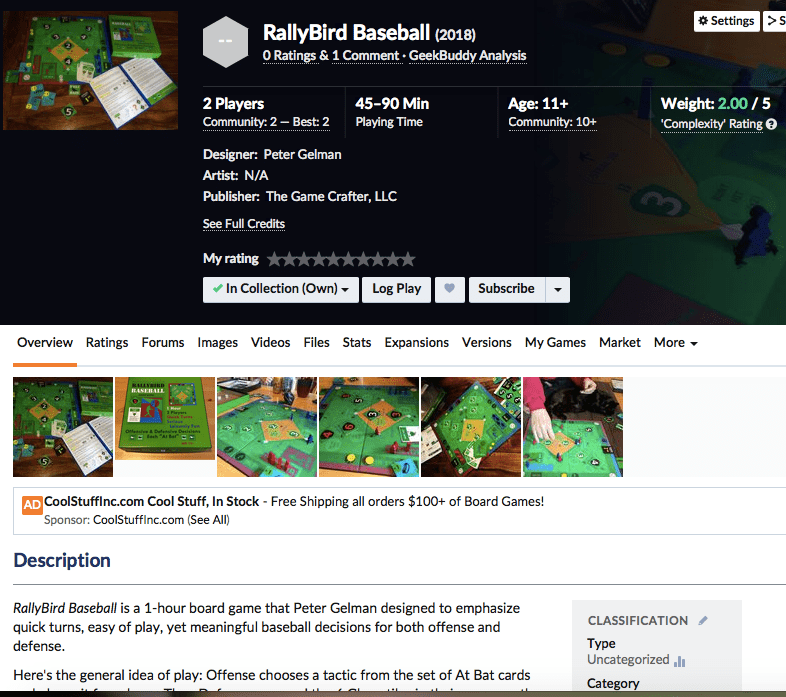
The RallyBird Baseball board game now has a presence on the premier board game website, Board Game Geek. If all goes right over time, more content about the game will show up there. Here’s the address (or click the picture below): https://boardgamegeek.com/boardgame/252879/rallybird-baseballScreen Shot 2018-05-27 at 10.47.40 AM.png

Theory 3: Baseball Offers a Natural Dramatic Structure

In this video I describe baseball’s natural dramatic storytelling structure. Yes I use a graph. There are two kinds of baseball dramatic structure. You may recall from grammar school the classic literary story graph with rising action leading to the climactic confrontation. The overall drama is the fatigue of the starter pitcher, the rising tension when the coach needs to send in the first reliever, and what happens next. I also argue that the baseball game includes mini dramas each half inning with the struggle of batters and baserunners against the hard limit of only 3 outs.

(If you’re looking for Theory 2, Baseball has dynamic topography, I appended the link below. And here’s the link where you can purchase the game. Thanks!


Theory 1: The Game of Baseball is Not Symmetrical

This new video replaces my previous effort on the same topic. It gives more description of my theory, and does not include a feline interference. I also quote from a baseball book as anecdotal support of my theory. In addition, it includes more specific information about how the theory influenced my board game design. I honestly don’t know if my theory is controversial or not. It’s probably not; however, I haven’t heard anyone talking about it in this manner. I hope you enjoy it. Feel free to let me know what you think!