Baseball Logic

In response to this question about a Runners In Scoring Position double play situation, I amended the rules to include this specification…

Screen Shot 2018-06-02 at 10.25.31 AM

This does not change any rules. It’s just a clarification that makes explicit the logic of baseball. I want people with different levels of baseball confidence to enjoy the game, so I’m happy to make this addition. I write about all this more extensively in my previous post.

Thanks to the RallyBird Baseball gamers who asked the question!

RISP then Double-Play? What Happens?

An early purchaser of the game contacted me with a request for clarification on this question which came up in a play session.

When there’s a runner on 1st and 2nd base and the batter hits a Grounder Right into a double play, does the runner on 2nd base advance?

Yes.

Let me fully specify. In RallyBird Baseball terms, the card that Offense played is one of these five:

Infield Right, Infield Left, Grounder Right, Grounder Left, Bunt Hit:

What happens in a common Double Play (dice < Gloves result) with no Outs if there are also runners on 2B, 3B? By common Double Play I mean with runner on 1B put out while forced to advance to 2B and the batter put out while advancing to 1B.

Baseball logic applies. Since there is a runner on 1st base, a runner on 2B must advance to 3B during the hit which quickly turns out to be a Double Play at 1B and 2B.

If there was also a runner on 3B (in other words Bases Loaded), the advancing runner from 2B to 3B in turn forces a runner on 3B to score. If there’s no runner on 2B, a runner on 3B stays on base during the Double Play result.

For Sac Right/Left in this situation, runners on 2B and 3B must hold. They had to return to base after the fielder caught the ball, and then the infielders had control of the ball.

Although baseball logic makes sense here, I’d like the game as much as possible to specify the resolution. I want players with different levels of baseball confidence to enjoy the game. I don’t think I can fit all this information on the respective cards, but will look for a place in the rules. Actually I already know there is no room in the rules, so will have to agonize a little…

Incidentally, if a runner scored on a double-play, that doesn’t count as an RBI for the batter! This is a clue to baseball tradition’s sense of relative value between outs and runs, and helps me think about the sacrifice fly & sacrifice bunt. I’d like to do another video on that topic, but I’m still cogitating and scribbling graphs in a dog-eared notebook.

(Runners on 2nd and 3rd base are Runners In Scoring Position in baseball lingo, or RISP. This is a good acronym to have in your ready baseball vocabulary.)

10th Inning, 1 Out, Need 1 Run to Tie…

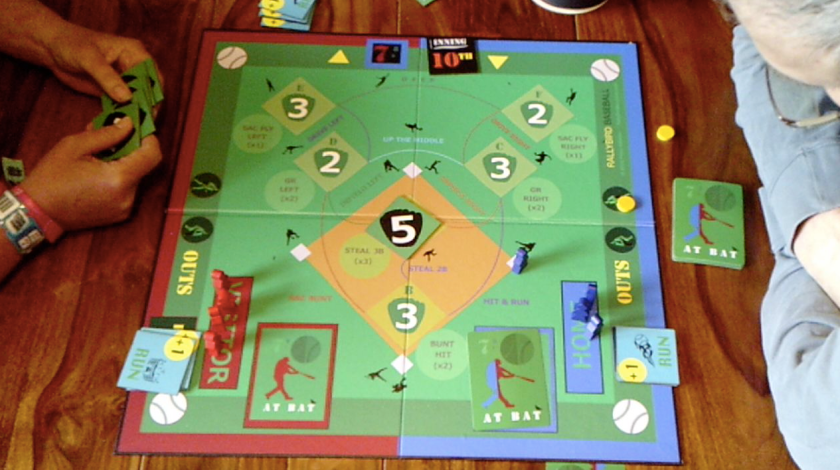
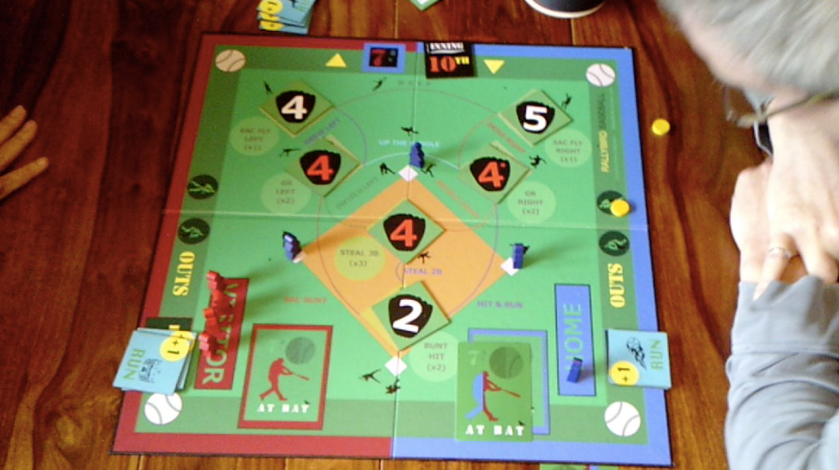
Here are sample pictures of a tense game situation in a recent play session of RallyBird Baseball. I’m on the right, playing Home (blue). The situation as we join us is… It’s the 10th inning, with 1 Out. Score is Red 3, Blue 2.

Note: The RallyBird made an appearance earlier, which I squandered, so it flew away. I’m on my own now!

The pictures below are screen grabs from the video I took of the match–while failing to turn the microphone on, as I mentioned in my previous post.

rb1
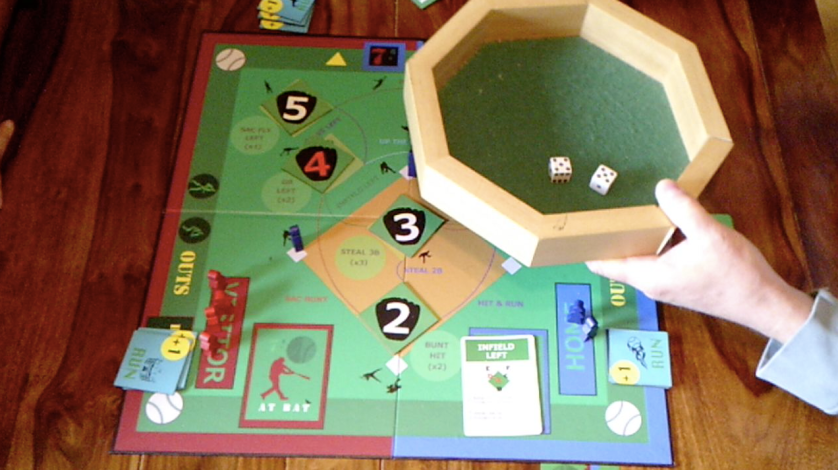
As blue offense, I made my At Bat decision and laid the card down. Red defense has started to place her defensive tiles, starting with the pitcher zone…
rb2
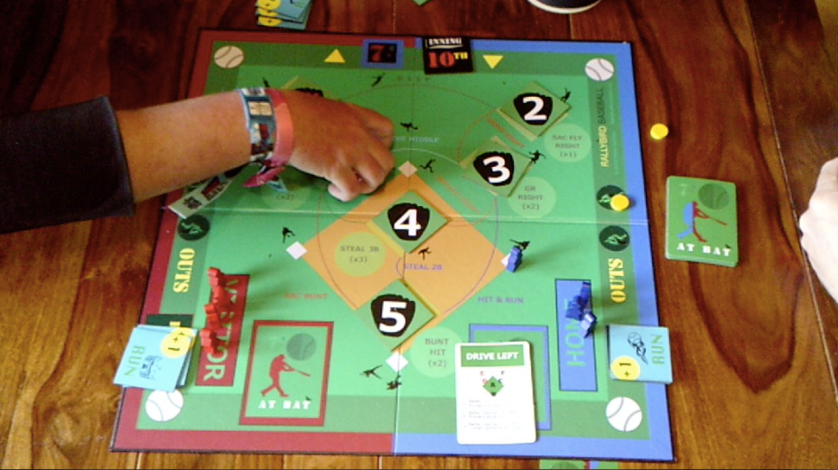
Red completes placing the defensive tiles
rb3
I reveal the At Bat card. It’s a hit that Drives Left. The sum of the relevant Glove zones is a 7. I roll the dice… a 9. Success!
rb4
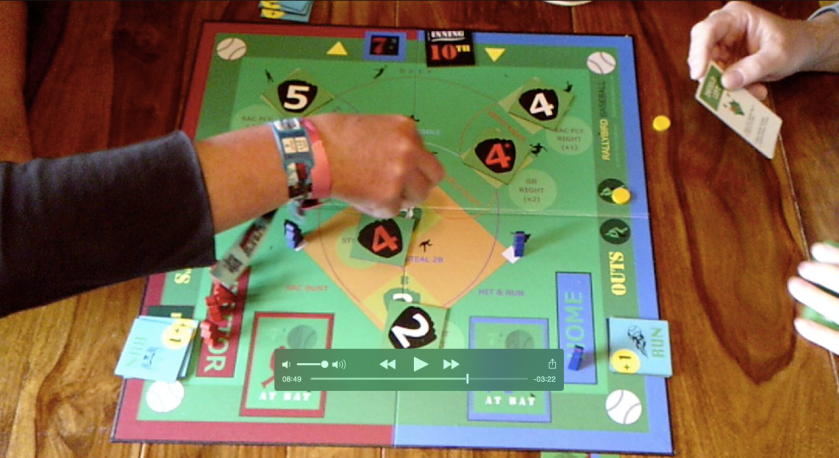
Since my Drive Left succeeded in moving a runner, Defense has to flip (if white numbered) or remove (if red numbered) one of the tested zones. She decides which one…
rb5
I move the runner tokens according to the result on the card for beating the Gloves sum–it was a double.
rb6
I take the Drive Left card back into my hand.
rb7
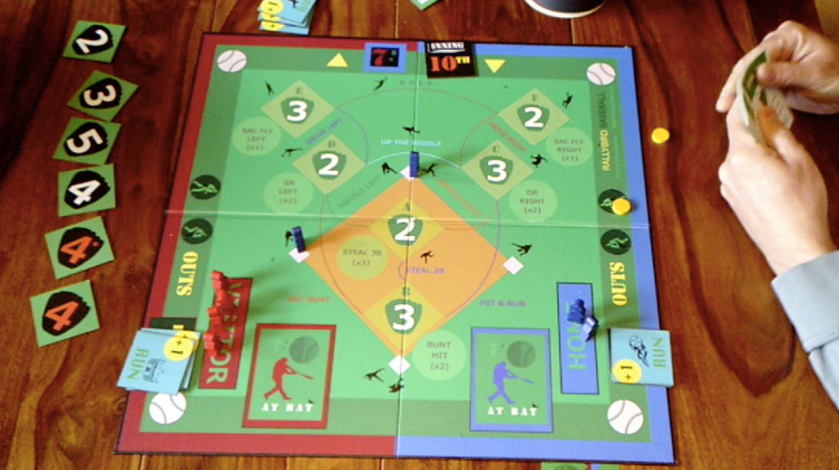
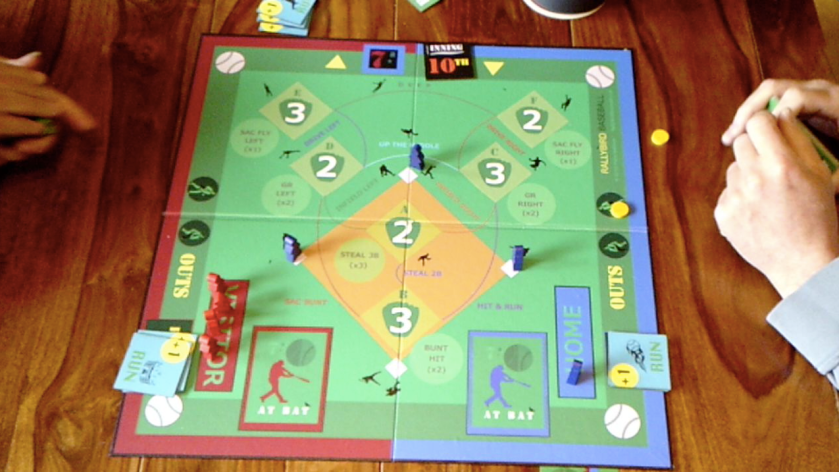
Here’s the situation as I consider the tactic for my next batter. I have set up runners on base in a way that avoids the common double-play threat. My opponent is showing her array of Glove tile values as a courtesy.
rb8
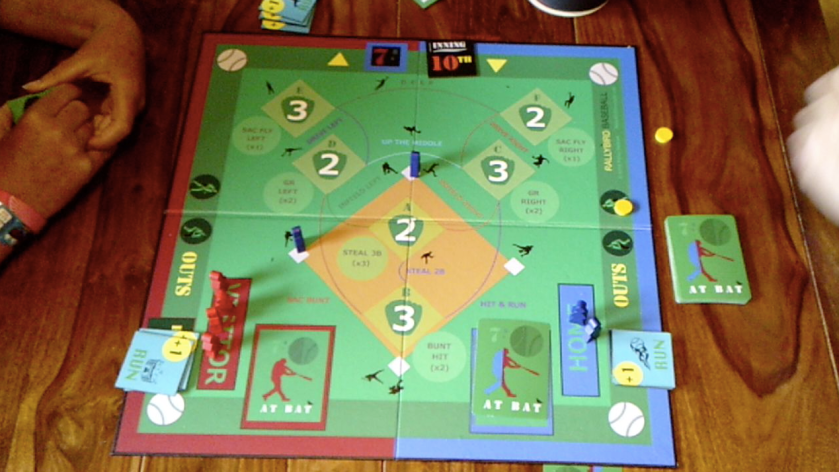
I select my next At Bat card and place it face down.
rb9
Visitor puts down her defensive Glove tiles. (Defense made an error I didn’t catch–she should have removed the red numbered 4 Glove that failed in the previous Drive Left.)
rb10
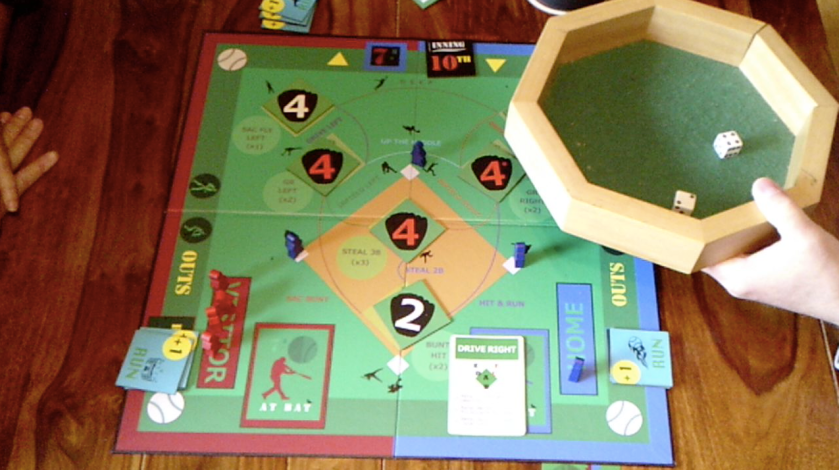
I reveal my At Bat card: Infield Left. The sum of the relevant Glove tiles is 7.
rb11
I roll the dice, a 10, which beats 7. Success! However, the details on this particular card explain that runners on base only advance if forced, so there’s no score.
rb12
Red (visitor) has to choose which Glove tile takes the impact. She flips the tile in the pitcher’s Glove zone. (Sorry that the screen capture includes the mute video play controls.)
rb13
Here’s the field situation as I contemplate my next At Bat. 10th Inning! Bases loaded!!! One out. Score is still 3-2. I’m one run behind…
rb14
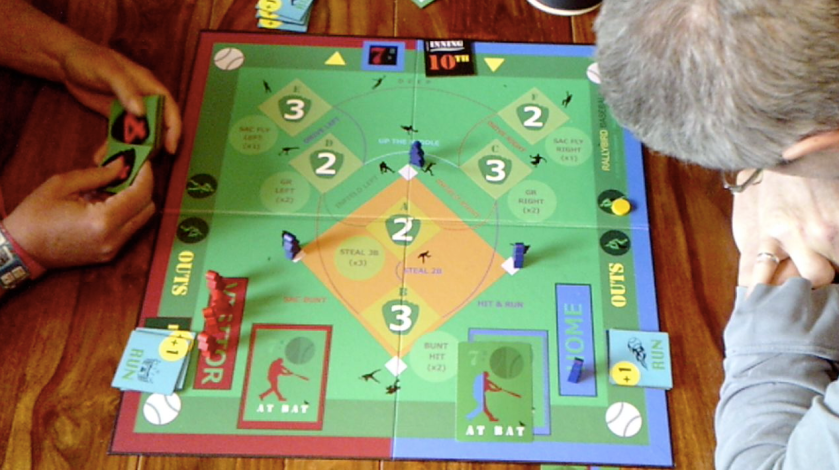
I made my decision and placed my At Bat card face down… Note that I’m looking down so my opponent cannot read my face, which she did earlier in the game.
rb15
Defense has placed her Glove tiles… Not that the course of the inning has lead her to have at this moment a lot of stronger Glove values, except for that 2. If I could hit at that weakness, it would help! I turn my face down to the table in nervousness…
rb16
Nope, I hit against her strength. I chose a Drive Right. Her relevant defense Glove zones add up to a value of 9.
rb17
My die roll result is a 6, quite less than a 9. Is that right? Is 6<9 or maybe 6>9 today? Should I challenge and have the HQ in New York check the video…. Oh no… It’s my second Out! Defense holds!


Here’s the situation… 10th inning, 2 outs, bases loaded, down by 1 run. And due to limitations with the video source, here I have to leave you hanging. Folks, it’s a mystery what happened next. Yep, I guess we’ll never know if I hit in another run or perhaps even two for a Walk-Off. No, we’ll never know.

Okay seriously my next At Bat was another Out… I left ducks on a pond stranded…  What a finish! Visitors 3 – Home 2 was the final score. Congrats to my worthy opponent M. who persevered in this tense game session of RallyBird Baseball.

If I can recover pictures of the remaining (tragic) play I’ll come back and add them.

Theory 3: Baseball Offers a Natural Dramatic Structure

In this video I describe baseball’s natural dramatic storytelling structure. Yes I use a graph. There are two kinds of baseball dramatic structure. You may recall from grammar school the classic literary story graph with rising action leading to the climactic confrontation. The overall drama is the fatigue of the starter pitcher, the rising tension when the coach needs to send in the first reliever, and what happens next. I also argue that the baseball game includes mini dramas each half inning with the struggle of batters and baserunners against the hard limit of only 3 outs.

(If you’re looking for Theory 2, Baseball has dynamic topography, I appended the link below. And here’s the link where you can purchase the game. Thanks!


Theory 1: The Game of Baseball is Not Symmetrical

This new video replaces my previous effort on the same topic. It gives more description of my theory, and does not include a feline interference. I also quote from a baseball book as anecdotal support of my theory. In addition, it includes more specific information about how the theory influenced my board game design. I honestly don’t know if my theory is controversial or not. It’s probably not; however, I haven’t heard anyone talking about it in this manner. I hope you enjoy it. Feel free to let me know what you think!