Theory 4 video: Baseball “Sacrifice” At Bat Evaluation (RallyBird Baseball Board Game)

What is the shape of value of the “sacrifice” At Bat in baseball? In this intuitive approach, I try to offer this. I call it a shape because it’s more than just a yes/no thing, more than a simple risk/reward relationship, but highly situational. Even when you consider all batters equal, there are still a lot of factors to weigh. The answer may have to be your choice of will, not your confident calculation. Lines and shapes are ways to try to wrangle the forces that push on the outcome.
Df6O3sMUEAA-9dl.jpg-large.jpegWhen you’re playing the RallyBird Baseball board game, you have the opportunity to make these evaluations for yourself based on your runners on base, how many outs you have, your inning, the number of runs you need, your opponent’s defensive style, and how many runs you want to score. What combination of risk and reward works best for you tactically and strategically?

This video explores the dimensions of risk and reward behind a decision to hit a ball in such a way to trade the batter’s Out to advance a runner already on base. To me its a fascinating risk/reward question with multiple, drifting variables. With all batters equal, when is it better or worse to hit a sacrifice rather than attempt a normal At Bat? This is one of the decisions you need to make when playing the RallyBird Baseball board game. As I say in the video, this need to make decisions provides the “good pain” in board games that I like.

For sale now (June, 2018) here: https://bit.ly/2rvmzBa .

Also see: RallyBirdBaseball.com . Thank you for watching.
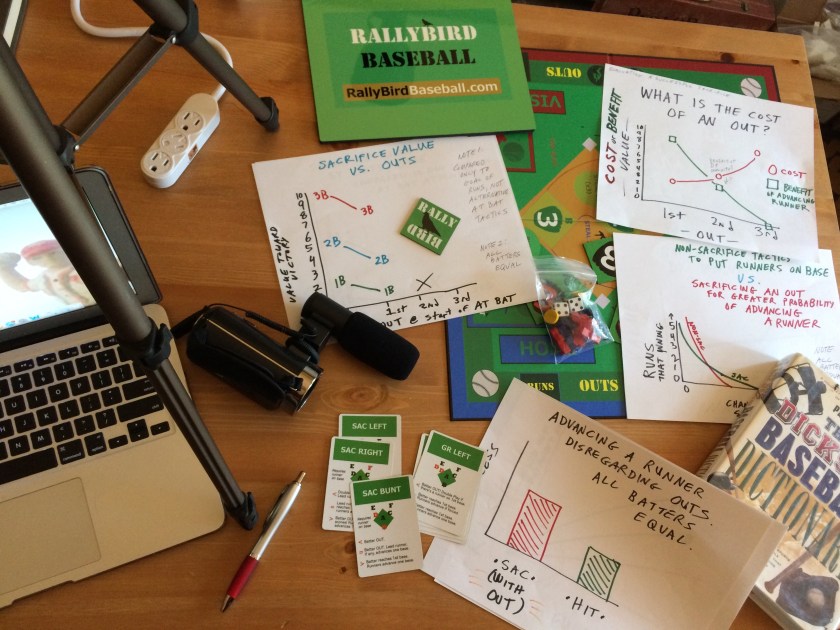
Preparations for the Next RallyBird Baseball Video. Topic: “Sacrifice” At Bats

With the assistance of graphs (see pic) I’m gathering my thoughts for my next RallyBird Baseball video to add to my previous five available on YouTube here.

SacFlyVideoPrepJune12,2018

While I can offer no computer graphics, I do offer my fuzzy, halting, semi-articulate, grainy human self. At least there are no PowerPoint slides, right?

Note to human self: turn on the microphone.

Additions to the RallyBird Baseball Beginner’s Guide

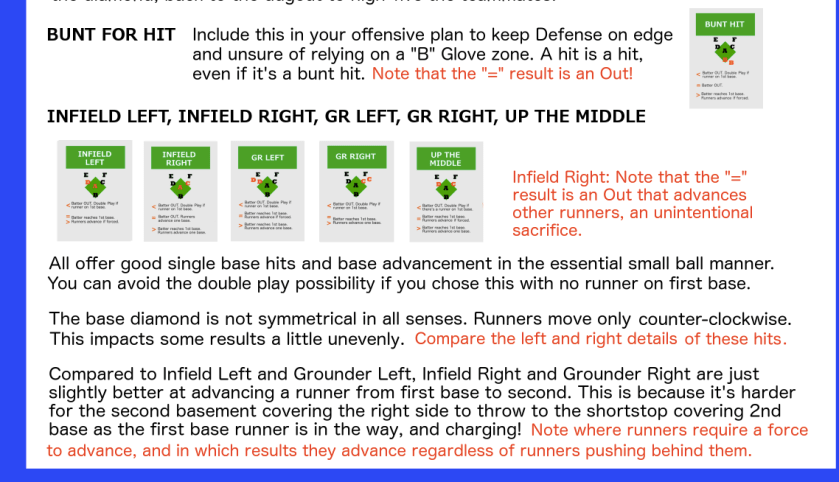
Discussions with early purchasers of the game motivated me to make a few pointed additions to the Beginner’s Guide pages of the RallyBird Baseball rules. These all have to do with the individual details of the cards–the ways in which they stand out from each other. A casual glance from a new player may not be enough to notice these idiosyncrasies.  (You can learn more about my rationale for it by watching my video explanation of baseball’s asymmetricity.) These At Bat differences will impact the success or failure of your offensive decisions.

You can see these changes in the red font of this screen capture:

Screen Shot 2018-06-05 at 12.20.19 PM

To be clear, none of this changes any rules or text on the cards. These discussions by the way are so helpful. I welcome your comments and questions. Play ball!

RISP then Double-Play? What Happens?

An early purchaser of the game contacted me with a request for clarification on this question which came up in a play session.

When there’s a runner on 1st and 2nd base and the batter hits a Grounder Right into a double play, does the runner on 2nd base advance?

Yes.

Let me fully specify. In RallyBird Baseball terms, the card that Offense played is one of these five:

Infield Right, Infield Left, Grounder Right, Grounder Left, Bunt Hit:

What happens in a common Double Play (dice < Gloves result) with no Outs if there are also runners on 2B, 3B? By common Double Play I mean with runner on 1B put out while forced to advance to 2B and the batter put out while advancing to 1B.

Baseball logic applies. Since there is a runner on 1st base, a runner on 2B must advance to 3B during the hit which quickly turns out to be a Double Play at 1B and 2B.

If there was also a runner on 3B (in other words Bases Loaded), the advancing runner from 2B to 3B in turn forces a runner on 3B to score. If there’s no runner on 2B, a runner on 3B stays on base during the Double Play result.

For Sac Right/Left in this situation, runners on 2B and 3B must hold. They had to return to base after the fielder caught the ball, and then the infielders had control of the ball.

Although baseball logic makes sense here, I’d like the game as much as possible to specify the resolution. I want players with different levels of baseball confidence to enjoy the game. I don’t think I can fit all this information on the respective cards, but will look for a place in the rules. Actually I already know there is no room in the rules, so will have to agonize a little…

Incidentally, if a runner scored on a double-play, that doesn’t count as an RBI for the batter! This is a clue to baseball tradition’s sense of relative value between outs and runs, and helps me think about the sacrifice fly & sacrifice bunt. I’d like to do another video on that topic, but I’m still cogitating and scribbling graphs in a dog-eared notebook.

(Runners on 2nd and 3rd base are Runners In Scoring Position in baseball lingo, or RISP. This is a good acronym to have in your ready baseball vocabulary.)